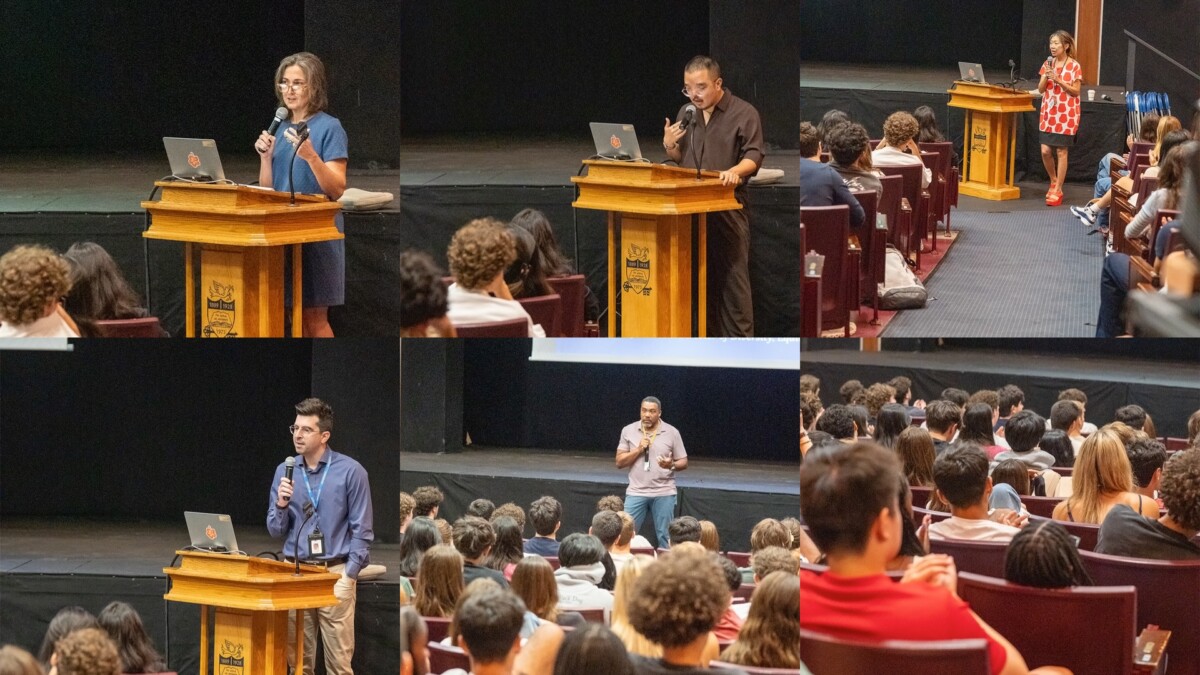
For many students, September 11, 2001, is a moment they know only through the stories of parents, teachers, and history books. Last week, in recognition of the 25th anniversary of the day’s tragic events, the D-E community gathered for assemblies in the Middle School (MS) and Upper School (US) to help ensure these stories—and the people behind them—are remembered.
Through faculty speakers who presented personal sentiments and historical context, students learned about the profound impact of 9/11 and the importance of carrying its lessons forward. Students were also given an opportunity to reflect on what it truly means to be in community.
During the Middle School Assembly, Jonathan Davis P’24, MS Principal, spoke to how D-E’s core values, including the ones of “Commitment” and “Community,” fully align with the importance of supporting one another. He noted, “It is so important to take care of each other during times of significant challenge; this idea is central to the ideas of demonstrating empathy and, in the words of D-E’s mission, to ‘as a community… make it better.’”
Mr. Davis also shared a compelling video clip about the massive boat lift rescue effort that transported more than 500,000 people to safety in the immediate aftermath of the events in Manhattan. Ms. Tasha Urbanowski P’20, ’22, who was a relatively new D-E faculty member at the time of the tragedy, then spoke to how the first thought that everyone had that day was “how can we take care of each other.”
Ms. Julie Choi opened the US Assembly, her first as US Principal, to welcome students and introduce Head of School Dr. James Calleroz White (“Dr. CW”), P’27, ’28, ’33, who told us he learned about the attacks while he was the Director of College Counseling at Belmont Hill School in Boston.
Dr. CW recalled being tasked with gathering the student body into the auditorium, so they could be informed of the horrific events that occurred when extremist group al-Qaeda hijacked four commercial planes and coordinated attacks against the United States, killing 2,977 people in New York; Arlington, Virginia; and Shanksville, Pennsylvania.
As Dr. CW closed the door behind him and looked out at the students before him, he held tight to a glimmer of hope. “What struck me amid the sense of tragedy happening around us and to us,” he said, “was that we were together in community, and, collectively, we were going to be okay.”
“Everyone has a story,” said Dr. CW, including each student that day. And students and faculty were all there to share one another’s stories, then and now. “Here [in this room] is that same kind of community,” he added. “We will always support each other… all the adults here, we got you.”
Dr. Dominic Vendell, Upper School History Teacher, then discussed 9/11 from a historical perspective. He referenced professor and writer Steve Stern’s “The Memory Box of Pinochet’s Chile,” to describe how members of a society struggle to process or remember a collective trauma.
He also noted that because many younger adults don’t remember the events at all (someone 30 today was only 5 when 9/11 happened), the onus is on historians to explain and contextualize the facts to future generations.
Dr. Vendell added that a recent New York Times report about how New Yorkers were misled about the air quality around the World Trade Center site in the months following the 9/11 attacks demonstrated that “we’re still learning about this history.”
Next, Ms. Emily Sclafani, Senior Advisor to the Head of School for Teaching and Learning, spoke about the political repercussions of the attacks, including power struggles about what justice means and how these decisions impact Americans’ due process rights under the Constitution.
Another consequence was identity-based bias, prejudice, and stereotyping that followed in the days, weeks, and months following the attacks, recounted Mr. Joel Lee ’17, Assistant Director of Diversity, Equity, Inclusion, & Belonging (US).
In a hopeful note, Mr. Lee added that a year after the attacks, D-E faculty/staff organized a daylong program that included workshops on topics such as the women in Islam, civil liberty, and eyewitness accounts of journalists who covered the attack on the World Trade Center. Musical performances, art exhibits, and poetry readings rounded out the day and helped put the complexities of 9/11 into meaningful context.
“There is a wealth of oral history in this room should the adults [who have a story about 9/11] choose to share,” said Mr. Lee. He also recommended students visit the commemorative plaques around campus that honor people in our D-E family who perished on 9/11. “The past is here with us if we pay enough attention,” he said.
Ms. Choi closed the assembly with a story of her own about that fateful day. She was teaching Japanese at a school in New York City and remembered the panic and questions that ensued once word got out. “I felt a responsibility [to my students] to hold it together,” she said.
The light at the end was that “everyone came together to see what they could do to help,” she said, including getting students fed and finding a way to get them home. “From that tragedy, we learned how to be in community,” she said.
To continue the conversation, there will be a Lunch and Learn for our Upper School students, featuring Dr. Vendell and Ms. Sclafani, on Friday, Sept. 18 in The Imperatore Library. In addition, Joe Daniels, the former president and CEO of the September 11 Memorial & Museum will be the guest speaker during an upcoming Upper School Assembly on Thursday, Sept. 17. Ms. Choi urged students to bring their attention and curiosity to these events.