Balancing Conceptual Understanding with Hands-On Experiences and Literacy
Submitted by Yi Li, Lower School Science and STEM Teacher
2nd Grade
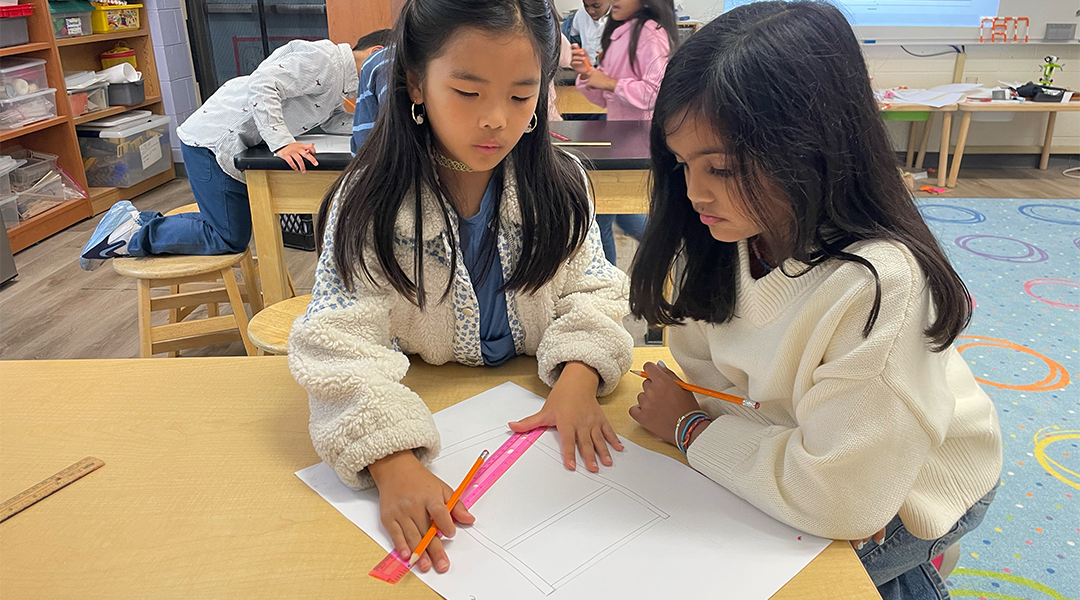
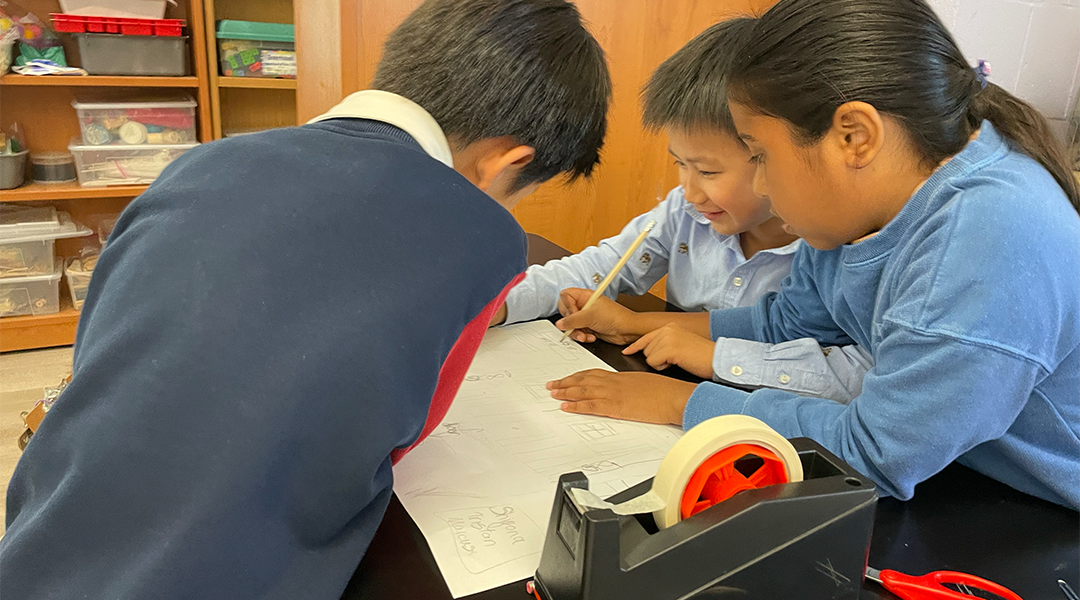
Second graders kicked off the school year with a unit on the properties of materials. Students worked in groups to explore different materials from a kit box and practiced using descriptive words for shape, color, and texture. They then began a collaborative project with third graders to design and build a house using paper straws. Through this project, students learned how to draw blueprints, communicate their ideas using complete sentences, and share their designs asynchronously with their peers. While continuing to build their paper straw houses, students are also learning to use connecting words to describe how the properties of materials relate to their functions.
3rd Grade
Third graders started the year exploring ecosystems. They learned about living and nonliving things and how these interact within an environment. In the process, they practiced sorting and supporting their reasoning using sentence structures like “A ___ is living because it ___.”
In addition to their ecosystem studies, they are collaborating asynchronously with the second graders on the house-building project—applying both creativity and scientific thinking.
4th Grade
Fourth graders are diving into the study of energy! They rotated through hands-on stations to observe how energy can be stored and released in different ways. Using an interactive simulation, they explored how kinetic and potential energy change as a skateboarder moves up and down a track—visualizing these changes through bar and pie graphs. After discussing patterns in science and how to use double comparatives or “as…, as…” structures to describe them, students were challenged to practice using these sentence starters to describe the patterns they identified in the simulation. Currently, they are learning how to write to describe observed patterns in their data. In STEM, students are learning how to define their own custom blocks in Scratch to make their coding more efficient—similar to how functions work in other programming languages.
5th Grade
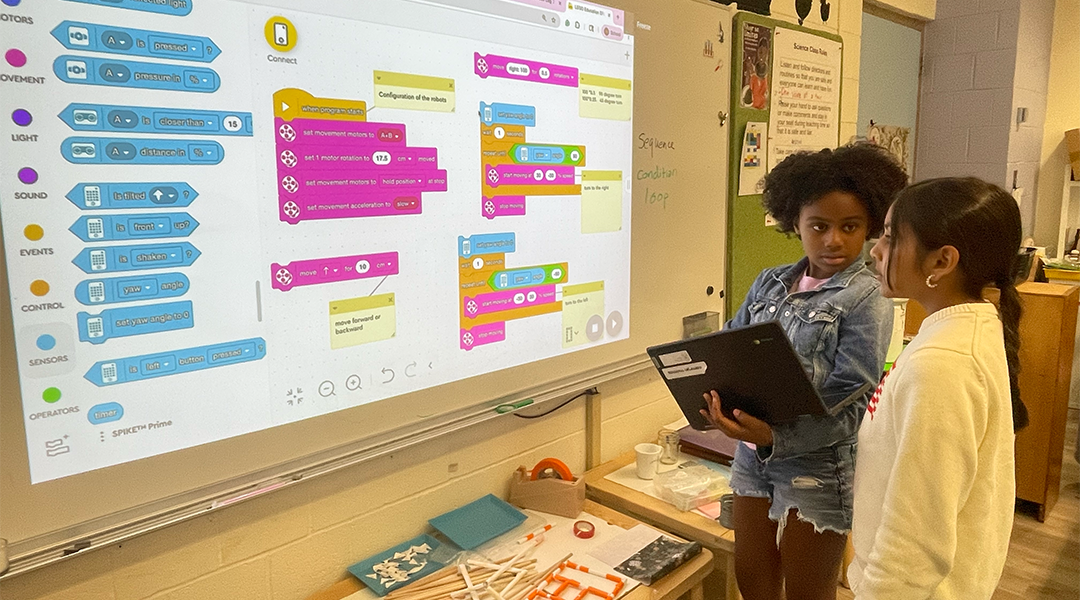
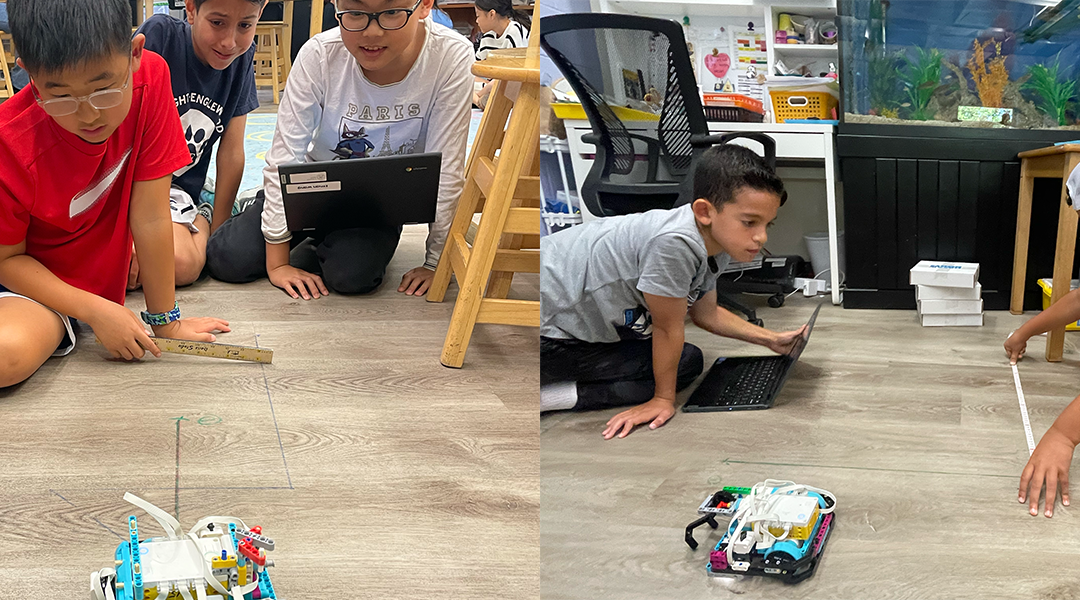
Fifth graders spent the first six weeks mastering Spike Prime robotics, the same platform used in middle school robotics teams. After learning key coding concepts such as sequence, condition, and loop, students practiced writing programs to move their robots forward, backward, and at different turning angles. In recent sessions, they have been working in pairs to program their robots to follow pre-drawn pathways on the floor—combining logic, precision, and teamwork!
Fifth graders have started learning about experimental design. They are practicing how to use the question format “How does A affect B?” to formulate research questions and how to write detailed procedures for their experiments.